DAB Digital Radio retune
March 3, 2016
KEF Reference Loudspeakers at Home Media
March 15, 2016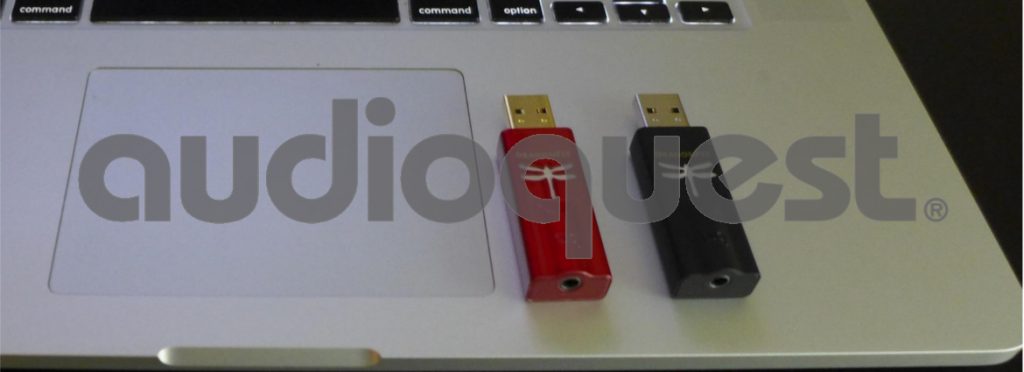
AUDIOQUEST DRAGONFLY BLACK & DRAGONFLY RED RELEASED TO REPLACE V1.2
PRE-ORDER NOW
>> DRAGONFLY BLACK <<
>> DRAGONFLY RED <<
AudioQuest’s thumb-key-sized DragonFly USB DAC might not have been the very first of its kind but it ultimately came to be the poster child of USB dongle DACs to which all rival units would be compared. The 2012 original was updated in 2014 to the DragonFly v1.2 with some all-round technical improvements. We are happy to report that there are two new upgraded models of Audioquest’s Dragonfly on the way. The new DragonFly Black and DragonFly Red USB DACs and Headphone Amplifiers will work with Apple and Android devices, as well as laptops and PCs as with the V1.2.
The first batch of shipments to the UK are due in mid April so pre-order now to secure your DragonFly.
DragonFly Black
Chief designer of DragonFly, Gordon Rankin had the idea of making more improvements to the DragonFly, with a ‘more for less’ approach. Enter the DragonFly Black. A similar look and style to the v1.2 but promising better sound quality for less dosh.
 This new model swaps out the forerunner’s v1.2’s TAS1020B – the chip that talks to the host device – for a solution from Arizona Microchip Technology. Their 32-bit MX270 USB micro-controller reportedly offers several key advantages over solutions from Texas Instruments or XMOS:
- Analogue power supplies on the chip mean a more favourable noise profile. The electrical characteristics of the MX240 do not vary with the incoming sample rate. Like the DragonFly v1.2 that it replaces, DragonFly Black will decode up to 24bit/96kHz PCM.
- Lower power consumption; iOS devices red card the DragonFly v1.2 because of its thirst for using over 100mA. Android devices enforce no such disconnect but suffer faster battery drain as a result. DragonFly Black’s MX240 controller consumes 77% less power than the outgoing TAS1020B and up to 95% less than even the most power efficient XMOS options. The upshot is the DragonFly Black is fully compatible with all iOS devices (with an Apple Camera Connection Kit) and any Android 4.1 device that also supports USB audio (with an OTG cable).
- Firmware upgradeability; The firmware on the original DragonFly v1.2 is locked in place at the factory. The DragonFly Black’s MX240 chip is firmware upgradeable via Audioquest’s forthcoming Windows and OS X apps. Consumers will be able to install performance updates and bug fixes, crucial to the more nebulous world of Android devices, as they become available via Audioquest’s website.
The unit’s dimensions remain unchanged (12mm x 19mm x 62mm), as does the analogue volume control but the decoder chip is new: out goes the 24bit ESS 9023 of yore, in comes the 32-bit ESS 9010 to which a minimum phase filter has been applied to give the listener “a more naturally detailed and dynamic” experience. And yes, DragonFly Black remains fully compatible (and driverless) with OS X and Windows devices.
DragonFly Red
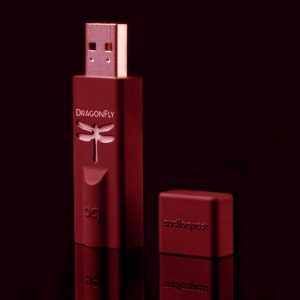 Audioquest are also introducing the more powerful DragonFly Red which, not only promises greater control of tougher headphone loads, but more audible beauty and finesse. DragonFly Red sports the same MX40 micro-controller and offers the same iOS/Android/OS X/Windows device compatibility as the Black but serves up a higher output voltage (2.1V) and 5db more signal to noise via a superior sounding 32-bit ESS 9016 decoder chip and 64-bit, bit-perfect digital volume attenuation. On both models, adjusting the volume control on the host device will send proxy signals for changes to both Red and Black’s on-board volume controls.
Head-fiers that love mobile device compatibility will likely appreciate how the DragonFly Black & DragonFly Red solutions are (quite literally) millimetres from being inline DACs/amplifiers, deftly side-stepping the need to strap on a bulkier box like a Chord Mojo. Plug an OTG USB cable into your Android device or hook a CCK into an iPhone and connect either DragonFly Red or Black for portable audio that’ll sound considerably better than your phone’s headphone socket. Moreover, these AudioQuest critters will really come into their own when Apple make good on their promise to rid the iPhone 7 of its analogue headphone output.